More about education. Groups, creativity...multi-dimensions...
Wednesday, April 20, 2011

The Liberal Arts Head Fake
All right. I’m a little late on this blog post, AGAIN. But it’s actually much better this way.
I think our friend Randy Pausch said it all for me. His “Last Lecture” tied up the ends of this semester so well that I almost can’t stand it. There goes that serendipity thing again.
This whole semester has been a tying up and tying-together kind of semester for me. All of my classes meshed together in incredible ways, from the obvious, like: Aristotelian arguments in Persuasion and Logic classes, to the slightly more obscure, such as: Theological perspectives in Early British Literature. The one class that really tied it all together, though? This one.
Dignity is literally everywhere, and I would NOT have been able to see that without this class. BUT HERE IS THE HEAD FAKE! This class would not have been made possible without (*drumroll*) the LIBERAL ARTS! Okay... so it wasn’t the best head fake... but I’m not Randy...
Randy’s lecture tied things up for me because of an extremely important realization I had this semester.
I have been educated.
I have been educated.
“Well DUUHH”, you all say, “You’ve been in COLLEGE”. True. But education isn’t just about that one definition. A very wise, and very dear, friend of mine told me this: Education is realizing how much you DON’T know. I could not have been educated (in either sense) without the Liberal Arts, and this class really helped me to realize that. This class breached walls and built bridges across all disciplines. I mean, heck, look at how many different MAJORS were in our class! The amount of things that I don’t know really hit me...hard.
With that being said, here is the conclusion that I have come to. Dignity can only exist where there are relationships between people, and those relationships require us to reach across the gaps that separate us as humans. We cannot see the dignity in someone else unless we can understand the multi-dimensional experience of being human (cue the Liberal Arts education).
Through the Liberal Arts, and subsequently capstone classes like this one, we are given the ability to discover ways to build new bridges and make new connections. Reaching across those gaps forces you to learn about yourself and others, and brings out the dignity inherent in all people. Dignity doesn’t stop in one discipline because learning never stops.
Dignity, then, also becomes group education. The recognition that you can’t do it alone. Great changes, while they may start with one person and one idea, can only come to fruition when they are communicated to a group. It is also important (and, as Dr. B said, intrinsic to us as humans) to be self-reflective, but we cannot EXIST without connections to other people. So does that hermit in the woods have dignity? In his own way, maybe... but he needs other people to make it full- fledged.
Randy placed a lot of emphasis on these connections. He reached across disciplines and maneuvered around his brick walls, and achieved his DREAMS. I think we can all agree that his was a life well-lived.
I’d like to end this reflection with a song (stand on your head if you’re shocked). You don’t have to listen to it, and you might think it’s a stretch, but it’s my way of wrapping up and I want to share.
This is a song by the Nitty Gritty Dirt Band (I can see the excitement in your eyes). It’s called “Lost River” and all this thinking about bridges and connections made me think of this song. I feel like Dignity is the Lost River, in this valley where no one goes... and we need to come back together and gather ‘round the pot-bellied stove and build us some new bridges... and hope we're not too far down to return to higher ground.
There's a lost river that flows
In a valley where no one goes,
Where the wild water's rush
Rumbles deep in the hush.
Gone far from there now,
Lord I'll be back somehow
To where the lost river winds
In the shadow of the pines
Refrain:
Oh, lost river, now I'm coming back
To the pot-belly stove, where the firewood's all stacked
Oh Quebec girl, go with me,
Oh my belle, my fleur de lis,
Where the lost river winds
In the shadow of the pines
Now everybody knows
Where that lost river flows
It's someplace he's lost
Behind bridges that he's crossed
Well, he'd like to return,
But his bridges are all burned
And he's much too far down
To return to higher ground
(Refrain)
Oh lost river, far over the ridge
Now is it too late for me to build me a new bridge?
To the bright golden time
When her love was still mine
And the world was still wild
Like the heart of a child
(Refrain)
Where the lost river winds
In the shadow of the pines
Wednesday, April 13, 2011
All the World's a Stage... for Dignity

All right, I’m late on my blog post again. But honestly, this one took me awhile to think about. Not that that’s really an excuse...
Anyway, I finally decided to use this picture. It’s the Antonian stage. Just the bare, quiet, stage. Why does this represent dignity to me? Because in our culture, all the world literally is a stage. Everyone wants to be famous. There are photojournalists and reality TV shows and YouTube, giving everyone the chance to stand out, no matter what the cost...including dignity.
But to me, this picture represents my definition of dignity. Dignity is inherent to all humans, but it would not exist without a social aspect, as well. Dignity is attributed to people based on their social contexts. Being on stage illustrates this. On the stage, actors give up their dignity for the sake of performance. For the duration of a play, they take on another dignity...the dignity of their character... and it is up to the audience to attribute that dignity. An actor may do undignified things on stage, but the indignities are attributed to the character. The stage allows people, for a brief moment, to become other people. Therefore, dignity is something that cannot exist without other people to say that it exists.
Now the picture brings up more questions. Do characters in plays have dignity at all, since they’re not real? Or are they given dignity by the playwright, then the actor, then the audience? If all the world is a stage, (as Jaques says in his famous speech in As You Like It), and performance is the experience of being human, are we all just performing our dignities? Does it really exist?
DUKE SENIOR.
Thou seest we are not all alone unhappy;
This wide and universal theatre
Presents more woeful pageants than the scene
Wherein we play in.
JAQUES.
All the world's a stage,
And all the men and women merely players;
They have their exits and their entrances;
And one man in his time plays many parts,
His acts being seven ages. At first the infant,
Mewling and puking in the nurse's arms;
Then the whining school-boy, with his satchel
And shining morning face, creeping like snail
Unwillingly to school. And then the lover,
Sighing like furnace, with a woeful ballad
Made to his mistress' eyebrow. Then a soldier,
Full of strange oaths, and bearded like the pard,
Jealous in honour, sudden and quick in quarrel,
Seeking the bubble reputation
Even in the cannon's mouth. And then the justice,
In fair round belly with good capon lin'd,
With eyes severe and beard of formal cut,
Full of wise saws and modern instances;
And so he plays his part. The sixth age shifts
Into the lean and slipper'd pantaloon,
With spectacles on nose and pouch on side;
His youthful hose, well sav'd, a world too wide
For his shrunk shank; and his big manly voice,
Turning again toward childish treble, pipes
And whistles in his sound. Last scene of all,
That ends this strange eventful history,
Is second childishness and mere oblivion;
Sans teeth, sans eyes, sans taste, sans everything.
This blog prompt has really made me ask more questions about the nature of dignity. I know that it’s the end of the semester, and we’re supposed to be taking stands, and I thought that I had, but having to encapsulate what I thought was my stand into a photograph really made me stop and think. How do I illustrate what I think dignity is?
I went back to what I know. I know performance and I know this stage. And now, because of this class, I know how to connect things to dignity...
Monday, April 4, 2011
The Afterlife
One more. Sort of goes with my point about the universality of death... this is just an interesting and maybe a little bit sarcastic take on it.
There is video for this one because it's off Paul Simon's not-even-released-yet (SQUEE!) album!
Paul Simon – The Afterlife
There is video for this one because it's off Paul Simon's not-even-released-yet (SQUEE!) album!
Paul Simon – The Afterlife
After I died, and the make up had dried, I went back to my place.
No moon that night, but a heavenly light shone on my face.
Still I thought it was odd, there was no sign of God just to usher me in.
Then a voice from above, sugar coated with Love said, “Let us begin”.
No moon that night, but a heavenly light shone on my face.
Still I thought it was odd, there was no sign of God just to usher me in.
Then a voice from above, sugar coated with Love said, “Let us begin”.
You got to fill out a form first, and then you wait in the line.
You got to fill out a form first, and then you wait in the line.
You got to fill out a form first, and then you wait in the line.
OK, a new kid in school, got to follow the rule, you got to learn the routine.
Woah, there’s a girl over there, with the sunshiny hair, like a homecomin’ queen.
I said, “Hey, what you say? It’s a glorious day, by the way how long you been dead?”
Maybe you, maybe me, maybe baby makes three, but she just shook her head…
Woah, there’s a girl over there, with the sunshiny hair, like a homecomin’ queen.
I said, “Hey, what you say? It’s a glorious day, by the way how long you been dead?”
Maybe you, maybe me, maybe baby makes three, but she just shook her head…
You got to fill out a form first, and then you wait in the line.
You got to fill out a form first, and then you wait in the line.
You got to fill out a form first, and then you wait in the line.
Buddah and Moses and all the noses from narrow to flat, had to stand in the line, just to glimpse the divine, what you think about that?
Well it seems like our fate to suffer and wait for the knowledge we seek.
It’s all his design, no one cuts in the line, no one here likes a sneak
Well it seems like our fate to suffer and wait for the knowledge we seek.
It’s all his design, no one cuts in the line, no one here likes a sneak
You got to fill out a form first, and then you wait in the line.
You got to fill out a form first, and then you wait in the line.
You got to fill out a form first, and then you wait in the line.
After you climb, up the ladder of time, the Lord God is here.
Face to face, in the vastness of space, your words disappear.
And you feel like swimming in an ocean of love, and the current is strong.
But all that remains when you try to explain is a fragment of song…
Lord is it, Be Bop A Lu La or Ooh Poppa Do
Lord, Be Bop A Lu La or Ooh Poppa Do
Be Bop A Lu La
Face to face, in the vastness of space, your words disappear.
And you feel like swimming in an ocean of love, and the current is strong.
But all that remains when you try to explain is a fragment of song…
Lord is it, Be Bop A Lu La or Ooh Poppa Do
Lord, Be Bop A Lu La or Ooh Poppa Do
Be Bop A Lu La
Citizen of the Planet
I posted that last post about life sentences and human dignity without any links or videos or pictures and I just couldn't let it stay that way. So I'm posting an epilogue in the form of a Simon and Garfunkel song called "Citizen of the Planet". I think it fits...
I am a citizen of the planet
I was born here
I'm going to die here
Come what may
I am entitled by my birth
To the treasures of the earth
No one must be denied these
No one must be denied
Easy dreams
At the end of a chain-smokin' day
Easy dreams at the end of the day
Who am I to believe
That the future we perceive
Lies in danger and the dangers increase
Who are we to demand
That the leaders of the land
Hear the voices of reason and peace
We are the citizens of the planet
We were born here
We're going to die here
Come what may
We are entitled by our birth
To the treasures of the earth
No one must be denied these
No one must be denied
Easy dreams at the end of a chain-smokin' day
Easy dreams at the end of the day
Who am I to deny
What my eyes can clearly see
And raise a child with a flame in his heart
Who are we to believe
That these thoughts are so naïve
When we've all disagreed from the start
We are the citizens of the planet
We were born here
We're gong to die here
Come what may
We are entitled by our birth
To the treasures of the earth
No one must be denied these
No one must be denied
Easy dreams at the end of a chain-smokin' day
Easy dreams at the end of the day
Of COURSE I couldn't find video or audio to go with this!!!! I think the Internet is violating my dignity by not allowing me to fully express and share my musical choices with others.
I am a citizen of the planet
I was born here
I'm going to die here
Come what may
I am entitled by my birth
To the treasures of the earth
No one must be denied these
No one must be denied
Easy dreams
At the end of a chain-smokin' day
Easy dreams at the end of the day
Who am I to believe
That the future we perceive
Lies in danger and the dangers increase
Who are we to demand
That the leaders of the land
Hear the voices of reason and peace
We are the citizens of the planet
We were born here
We're going to die here
Come what may
We are entitled by our birth
To the treasures of the earth
No one must be denied these
No one must be denied
Easy dreams at the end of a chain-smokin' day
Easy dreams at the end of the day
Who am I to deny
What my eyes can clearly see
And raise a child with a flame in his heart
Who are we to believe
That these thoughts are so naïve
When we've all disagreed from the start
We are the citizens of the planet
We were born here
We're gong to die here
Come what may
We are entitled by our birth
To the treasures of the earth
No one must be denied these
No one must be denied
Easy dreams at the end of a chain-smokin' day
Easy dreams at the end of the day
Of COURSE I couldn't find video or audio to go with this!!!! I think the Internet is violating my dignity by not allowing me to fully express and share my musical choices with others.
Standing Up for Life
We are being encouraged to take a stand... here is my stand: Life imprisonment might diminish human dignity, but it is the lesser of two evils in the capital punishment debate. I have issues with the death penalty... abruptly ending a person’s life, even if they are a criminal is wrong and unfair. Personally, I think the death penalty is more against Kantian principles than life sentences. (The DeBaco article about life sentences and human dignity says that life imprisonment uses people as a means to an end). The Categorical Imperative basically states that you should treat people as ends in themselves and that all people, everywhere should be treated that way, and finally, you shouldn’t hold others up to a standard that you would not hold yourself up to. I don’t think it’s fair to take someone’s life as punishment. We are all going to die anyway...who are we to take a life before it's been lived out, no matter how that person chooses to live it?
The DeBaco article asks which is more contrary to human dignity: execution or being excluded from society forever? Both of them are contrary to human dignity, as both of them are about excluding someone from society forever. But in one case, that person is excluded and isn’t coming back, while in the other case, that person still has their right to live and a right to rehabilitation (also discussed in the article). Sure, there is no guarantee that a person will reform. I believe that there are evil people in the world who will never change, but even they have dignity. I don’t think it’s anyone’s place to knock those people off the planet when they know that they wouldn’t want to be knocked off the planet themselves.
Yes. I still hold this stance for people like Sadaam Hussein. I don’t think it was right to take his life. For the reasons I mentioned above, and because I believe he actually wanted to die and it would have been a greater punishment to let him live. Giving him the Doritos he asked for was unnecessary, but you get my point.
I like what DeBaco had to say about the right to rehabilitation. Even though it’s not a guarantee, allowing a person the right to regain some status as a viable member of society is better than snuffing their candle. I know, we can’t force people to reform, but maybe we need to tweak our system so that there is some kind of voluntary offering for prisoners with long or life sentences. After a certain amount of time, they should be given the opportunity to re-enter society, but one that they could refuse. It’s not fair to force reform, either.
What I am really trying to get at is this: I don’t believe that ANYONE is really OK with the concept of dying. I don’t care what your major is, your profession, anything... Act as macho about it as you want. Somewhere, deep down, there is fear. It is NOT OK to take that fear out on criminals by executing them. Of course, it was NOT OK for those criminals to take the lives that they took, so why does it make us better to kill them back?
Tuesday, March 29, 2011
Mentally Challenging...
There are a lot of social stigmas around "mentally challenged" people. Our language here in the U.S. reflects our attitudes about people who have mental illnesses. We call people “retards” when we are commenting on something that they did that was sub-standard. I’m guilty of it too. The word is thrown around as if it is something that those people can change, like an ugly hat or mismatched shoes. This is how we take away the dignity of those people. We use their “problems” as insults, and most of them probably don’t even realize it!
Those people are not any different than we are. They just have to go about their lives in different ways. It’s like anyone with a “disability”, permanent or temporary. As I discussed in my Milton post, those people have to overcome obstacles and in doing so have a higher development of their other senses. People who are “mentally challenged” (whatever you want to call it), are simple...more things make them happy more easily. They aren’t constrained by the same day-to-day stresses that we have.
Those people are not any different than we are. They just have to go about their lives in different ways. It’s like anyone with a “disability”, permanent or temporary. As I discussed in my Milton post, those people have to overcome obstacles and in doing so have a higher development of their other senses. People who are “mentally challenged” (whatever you want to call it), are simple...more things make them happy more easily. They aren’t constrained by the same day-to-day stresses that we have.
The example I keep coming up with to restore the dignity of those people is through a comedian (shock, surprise). Ralphie May discusses the use of the word “retarded” in our vernacular. For as comedic as it’s supposed to be, he does make interesting points.
The segment comes in two clips. The first is his intro and the second is a story about his friend.
His story about Rusty is a short (albeit, slightly crude) statement on tolerance... later on in the segment (the clip ends very abruptly) he summarizes by discussing how much happier “retarded” people are than the rest of us because they have the capacity to appreciate the little things in life.
I think that we can go all the way back to Kateb and say that every human has dignity and when we engage in acts that harm another’s dignity we are also harming ourselves. We should mentally challenge ourselves to watch how we use our language and how it affects the dignity of others.
Monday, March 21, 2011
Dealing With Disability... My Milton Moment
Last week’s experiential learning was really eye-opening (horrible pun, I’m sorry) in many ways. It really highlighted the difficulties that people with disabilities face, and I can now appreciate their hardships in light of how easy it is for me to do things. It’s not that I didn’t care before… but thinking about those people along with the implications for their dignity has, in a way, made me care more. I appreciate what I have, and I appreciate people with disabilities who are making the most of what they have.
Our reflective discussion about blindness stuck with me the most. It was interesting to hear other people’s perspectives on blindness and their experiences with blind people or their reactions to the activity. I have often wondered what it would be like to be blind, and I still find it hard to imagine, even after our experiential learning. All I know is that I am amazed at, impressed with, proud of, etc. people who are blind and the ways that they overcome that obstacle. Whether blind from birth or not, I’m impressed either way. I continued to mull it over this week, and as I was reading Milton’s Paradise Lost, the light bulb in my head clicked on.
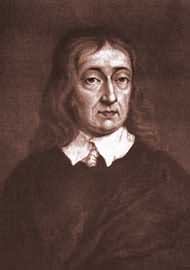
John Milton went completely blind in 1652. He had already written a number of sonnets and other works, and one would think that writing would have to stop when sight stopped, right? Wrong. Milton actually “wrote” his epic poem Paradise Lost in the 1670s by dictating it to his daughter (I believe). He also continued to write other essays and poetry, including this sonnet that he wrote soon after he had gone blind:
When I Consider How My Light Is Spent
When I consider how my light is spent,
Ere half my days in this dark world and wide,
And that one talent which is death to hide
Lodged with me useless, though my soul more bent
To serve therewith my Maker, and present
My true account, lest He returning chide;
"Doth God exact day-labor, light denied?"
I fondly ask. But Patience, to prevent
That murmur, soon replies, "God doth not need
Either man's work or His own gifts. Who best
Bear His mild yoke, they serve Him best. His state
Is kingly: thousands at His bidding speed,
And post o'er land and ocean without rest;
They also serve who only stand and wait."
Now here is a man who has overcome his disability. This sonnet speaks to a lot of the things that we brought up in our discussion, mainly the question of “What would you do if you became blind now, after having eyesight all your life?” How would you react if your “light” were suddenly “spent” (extinguished)? Milton accepts it. He appreciates the light that he was given before, and understands that he can continue to serve his God (he was a Puritan, by the way), even without the gift of sight.
Blind people are not without sight. If anything, they have more. The other senses become heightened, and I believe that includes some senses that those of us with eyesight don’t know that we have. In a way, people with disabilities are more appreciative of their dignity because they have to work harder to uphold it in this world of people who can see. It’s easier for us with eyesight to violate dignity because we only see without really looking. We rush without appreciating. We aren’t as careful as we should be because we are caught up in superficiality and make judgment calls based on what we see without taking the time to go deeper.
I suppose what I’m trying to say is that we should maybe take a cue from Milton (if nothing else) and recognize the gifts we’re given that are more than just what we can see. We should appreciate them both in ourselves and in others.
Monday, February 28, 2011
Sacredness of Creation and Dignity
I love it when life synchronizes. I attended another concert over the weekend and during the encore, everyone was standing up, clapping and sheering enthusiastically. But you know how you clap and cheer for an encore because you KNOW it’s going to happen? So you just keep clapping until the performers reappear… That’s what was happening at this concert. The clapping subsided when they sat down to play again. Then John Gorka (one of the artists) said something along the lines of:
“Thank you for clapping until we got back. Usually we’re kind of rushing back out…so, thanks for letting us preserve our dignity”
I was struck by his comment. The idea that people might not have the respect for the artists to at least clap until they returned to the stage was a little surprising. Also, the idea that dignity is contained in the acceptance of that performance was highlighted by the fact that I had chosen Sacredness of Creation as the Carlow Core Value to practice this week.
John Gorka’s quote synthesized Sacredness of Creation and dignity. (What a great way to end the week!) Sacredness of Creation doesn’t just mean being nice to the plants and the animals. Humans are a part of creation (whether it’s God’s or not is up to you) and we have a special place within it. Humans are creators. We build buildings and bridges, but we also create abstract things, like music and art.
Appreciating and respecting the artistic creation of another person lends them dignity. There is sacredness in their creation, and the expression of it should be appreciated. You don’t have to like it, but respect it.
Monday, February 21, 2011
Pope John Paul II: Dignity Upheld Through Forgiveness
Whether you’re religious or not, believe in the Pope or not, no matter what background you come from, the concepts of love and compassion are as universal as the concept of dignity.
On May 13, 1981, Pope John Paul II was making his usual trip through the crowds in Vatican Square when four shots rang out through the crowd, each of them hitting the Pope. The crowd watched in horror as their beloved Pontiff collapsed, bleeding heavily. He was rushed to the hospital, where he underwent a 6-hour long surgery that he barely survived. There were also two bystanders that were injured in the attack.
The almost-assassin was 23-year-old Turkish terrorist Mehmet Ali Agca. Without delving too much into politics, Agca was part of a political group who hated the Pope and all of his ideals. He had recently escaped from prison, where he was being held for murdering a prominent Turkish newspaper editor. So he was a bad guy… and the world was happy to see him sentenced to life in an Italian prison for attempted murder.
The Pope made a full recovery, to the relief of many (yes, yes, especially Catholics). Of course, the knee-jerk reaction to an act of terror is exactly that—terror. Terror brings anger, hate, prejudice, misunderstanding, and all manner of negative feelings and emotions. Look at Americans’ reactions to the September 11th attacks. The last thing that anyone wanted to do was forgive the people that caused those emotions.
Pope John Paul II taught the whole world a lesson in 1984 when he visited Agca in prison. In an intensely hushed meeting, with only the Pope’s press secretary and photographer in attendance, John Paul II managed to make a global proclamation of forgiveness. He reconciled with his attempted killer, saying later that the teachings of Christ spurred him to do so.

Even when you take the religion out of it and you still have a dramatic story showing an act of dignity upheld. The Pope put aside all differences between him and Agca, and out of a love for his fellow human exemplified the true meaning of “love thy neighbor”. He upheld the dignity of one who the majority of people were ready to condemn immediately, demonstrating the overreaching and non-judgmental power of love.
This is an excerpt from the Social Doctrine of the Church. It applies to everyone…not just those who follow a Christian God:
Discovering that they are loved by God, people come to understand their own transcendent dignity, they learn not to be satisfied with only themselves but to encounter their neighbour in a network of relationships that are ever more authentically human. Men and women who are made “new” by the love of God are able to change the rules and the quality of relationships, transforming even social structures. They are people capable of bringing peace where there is conflict, of building and nurturing fraternal relationships where there is hatred, of seeking justice where there prevails the exploitation of man by man. Only love is capable of radically transforming the relationships that men maintain among themselves. This is the perspective that allows every person of good will to perceive the broad horizons of justice and human development in truth and goodness.
If you still think I’m a religious whacko because I chose this as my example of dignity upheld, just remember the other philosophies operating in this story. It contains elements of Kant’s Categorical Imperative, Kateb’s ideas on dignity as a universally human attribute, Rawls on self-respect, and even, somehow, Singer’s ideas about relationships and human worth. Not so mainstream religion, now, is it?
References and Relevant Articles:
Wednesday, February 16, 2011
City of Pittsburgh Violates Dignity
Preparation for the G20 Summit in Pittsburgh last September was akin to locking down a castle in the face of a siege. No one could get in, and no one was brave enough to venture out. Hundreds of extra police officers were hired for the weekend, and they were armed to the teeth, expecting the worst. Stories of past G20 Summits in other cities had Pittsburgh in a tense state, waiting for the swarms of demonstrators and protestors that were expected.
Of course, those protesters came. Or they tried to. In order to protest in the City of Pittsburgh, you must be granted a permit. Sounds reasonable, doesn’t it? Sure. I think it is reasonable for the city to have some control over who is protesting and where, in order to retain some modicum of organization. So, like any law-abiding citizens, the protest groups applied for their permits to protest at the G20 Summit. The city only actually granted 2 of those permits. Why? To stave off potential destruction?

The city refused to cooperate with the demonstrators, stifling their protests by citing their law books so that they didn’t seem wrong. They were operating from the horror stories of other cities, and attempting to subtly save themselves the possible destruction the protestors would cause by conveniently not approving the permits until it was too late.
The city refused to cooperate with the demonstrators, stifling their protests by citing their law books so that they didn’t seem wrong. They were operating from the horror stories of other cities, and attempting to subtly save themselves the possible destruction the protestors would cause by conveniently not approving the permits until it was too late.
They were wrong in a big way, however. The City of Pittsburgh managed to violate the dignity of all of those protestors by denying them their rights to free expression and free assembly. Their reasoning was based solely on the “potential” for violence, which pushes this to an issue of paternalism. Did the City have the right to deny those permits just because it was the “safe” thing to do? I don’t think so.
The dignity of those protestors was violated when their freedom to express themselves was stifled, and the dignity of all of the citizens of Pittsburgh was violated when the City violated our right to choose what is best for us by stifling those protests “for our own good”.
Dignity is inherent in those freedoms, and is violated when they are infringed upon.
Resources and Articles:
City sets up protest areas, but protest groups eye lawsuits over permit delays
6 groups sue Pittsburgh for protest permits Civil Rights Groups Sue PittsburghPittsburgh deploys teargas and sirens to keep G20 demonstrators at bay
G20 Protesters Ordered to Stop March by Pittsburgh Police
6 groups sue Pittsburgh for protest permits Civil Rights Groups Sue PittsburghPittsburgh deploys teargas and sirens to keep G20 demonstrators at bay
G20 Protesters Ordered to Stop March by Pittsburgh Police
Sunday, February 6, 2011
Thing Called Love
I was at one of the best concerts that I have ever experienced in my entire life a couple of weeks ago. It's going to take a lot to top it, anyway...
The concert was John Hiatt and Lyle Lovett, honestly two of the best musician/singer/songwriters in the rock world. My opinion.
One of John Hiatt's biggest hits is "Thing Called Love".
Check out these lyrics (it's amazing how this class creeps into everything):
Don't have to humble yourself to me
I ain't your judge or your king
And baby, you know you ain't no Queen of Sheba
And we may not even have our dignity, no
This could be just a prideful thing
But baby, we can choose you know,
We ain't no amoebas
But
[Chorus:]
Are you ready for this thing called love
Don't come from you and me,
It comes from up above
I ain't no porcupine, take off your kid gloves
Are you ready for this thing called love
And you ain't some icon carved out of soap
Sent down here to clean up my reputation
And baby, I ain't your prince charming
Now we can live in fear, or act out of hope
For some kind of peaceful situation
Baby, don't know why the cry of love is so alarming
But
[Chorus]
The ugly ducklings don't turn into swans
And glide off down the lake
Whether your sunglasses are off or on
You only see the world you make
Before the laws of God and the laws of man
I take you for my wife, yeah
To love, honour, cherish and obey,
Now, I didn't have no plans to live
This kind of life, no
It just worked out that way
And
[Chorus 2x]
Just a crazy little thing called love
Its justs a crazy little thing called love
This song means much more to me now. It's not just about romantic love. It's about the universality of love. It doesn't matter who you are (the Queen of Sheba, Prince Charming) love and dignity begin with a relationship between two people. When people treat each other with genuine care and affection, it sets an example. We just have to be ready for it.
People aren't porcupines (so take off those kid gloves), we can touch them, literally and figuratively, and we should.
Here is a video (not the best, but I have trouble finding my music on Youtube):
John Hiatt and Lyle Lovett perform "Thing Called Love" on David Letterman
Monday, January 31, 2011
Dignity in the Netherlands
I’m not sure why I chose the Netherlands to answer to this prompt. Well, it might have had something to do with my having just read Beowulf in my British Literature class and my tying together the notions of dignity and honor with the concept of “flyting”, or socially acceptable boasting. Anyway, the general culture of the Netherlands is still centered on pride and to a great degree, freedom. They just aren’t fighting for their honor with swords, shields and helmets anymore.

Their sense of the notions of pride and freedom now are slightly different from our conceptions of them. Where we tend to group those two concepts into one notion of “nationalism”, the people of the Netherlands do not have a sense of a unifying national culture. Instead, they pride themselves on their degree of acceptance of many cultural differences. They love the idea of diversity, and that acts as their unifying power. This is much like America, where we are a “melting pot”, but we still manage to unite the concept of “being American” under that principle. In the Netherlands, they emphasize those differences, finding the concept of “nationalism” as we see it unnecessary.

I looked up the Constitution of the Netherlands and the first article of the first chapter (they do not have a preamble) states:
All persons in the Netherlands shall be treated equally in equal circumstances. Discrimination on the grounds of religion, belief, political opinion, race, or sex or on any other grounds whatsoever shall not be permitted.
To me, the fact that the Netherlands places so much emphasis on diversity and equality means that their notion of dignity coincides with the concept that dignity is universal. Everyone in the Netherlands strives to treat everyone with equality, regardless of their background, giving everyone a sense of dignity.
Of course, I believe that we should all strive to treat dignity this way, and I believe that in a sense, we all do strive to be this way. But maybe it would be easier if we too emphasized our differences from each other and treated everyone with the dignity they deserve as free and individual people.
References:
Monday, January 24, 2011
Empathy, Autonomy and Dignity
“… being made to suffer, bodily and materially, is not conceptually the same wrong as being treated as if one is not a human being. Lastly, I believe that though a human being can never forfeit his or her dignity and thus become legitimately open to any kind of inhuman treatment, one assaults one’s own dignity when one is a party to serious injustice, or systemic oppression, or to evil as a policy; one is acting as if one were more than human, or more human than those whose victimization one causes or calmly accepts as nothing untoward.” (Kateb 13)
If we go by a definition of dignity that says it is an essential element to being human and that it is something that all human beings are born with, then it is impossible to forfeit that dignity willingly. Forfeiting dignity would be forfeiting your humanity, and that is impossible. There are other essential elements that make humans different from other species. The capacity to empathize with one another is another of these elements. Empathy implies that humans have the moral capacity to recognize each others’ needs. I believe then, that taking away empathy takes away dignity, and that is how dignity is forfeited. A person who refuses to empathize with another has sacrificed an essential part of being human in themselves and is also denying the other person that capacity.
The idea of empathy also brings up another element of dignity and humanity, that is, autonomy. A person’s individuality and capacity to make decisions is another part of what gives them dignity. When their autonomy is infringed upon, so is their dignity. To refer back to Kateb and his idea that one assaults one’s own dignity when they play a part in injustice, it is an injustice to take away a person’s autonomy. To do so is to forfeit the capacity to empathize, which infringes upon autonomy and also upon dignity.
This is what I think so far, in response to this passage in Kateb’s article. I know I need to check on the philosophical implications I am making, but this is how I have thought it through. Obviously this response will change and clarify itself as we discuss more.
Wednesday, January 19, 2011
Time of Inconvenience
I've been on a Nanci Griffith musical kick for the past few days, and I notice that she touches on a lot of points that deal with the concept of human dignity.
This song, "Time of Inconvenience" puts an interesting twist on the state of the world, and how inconvenient the times really are.
This song, "Time of Inconvenience" puts an interesting twist on the state of the world, and how inconvenient the times really are.
Time of Inconvenience (1994)
We're living in a time of inconvenience
Compassion fails me with this meanness in the air
Our city streets are filled with violence
So we close our doors to the city
And pretend that it's not there
Here I go again
Back out on these mean streets
The evil seems to cling to the soles of my feet
'cause' I'm living in a time of inconvenience
At an inconvenient time
We're living in the age of communication
Where the only voices heard have money in their hands
Where greed has become a sophistication
And if you ain't got money
You ain't got nothin' in this land
An' here I am one lonely woman
On these mean streets
Where the right to life man has become my enemy
'cause' I'm living in his time of inconvenience
At an inconvenient time
(bridge)
I've turned my cheek
As my history fades
While the clock ticks away
Any progress we've made
I never thought
I'd be ashamed to be human
Afraid to say
My time has seen it's day
'cause' I'm living in a time of inconvenience
living in a time of inconvenience living in a time of inconvenience
It's an inconvenient time
This is the time of greed and power
Where everyone needs to have someone to shove around
Our children come to us for answers
Listening for freedom but they don't know the sound
And there they are, our children
Dumped out in these mean streets
The evil sweeps them up
And brings them to their knees
'cause' they're living in our time of inconvenience
They're living in the age of communication
This is the time of greed and power
This is the time that I wish was not mine
'cause' it's an inconvenient time
(time, oh time)
(it's an inconvenient time)
Nanci Griffith manages to encapsulate much of what we talked about this past class. Status, power, communication, rights... here it is in a 4 minute song. It's an interesting jumping off point for discussion on how all of this applies to dignity, if it does at all.
Monday, January 17, 2011
A Most Peculiar Man
A Most Peculiar Man (P. Simon, 1965)
He was a most peculiar man.
He was a most peculiar man.
That's what Mrs. Riordan said and she should know;
She lived upstairs from him
She said he was a most peculiar man.
He was a most peculiar man.
He lived all alone within a house,
Within a room, within himself,
A most peculiar man.
He had no friends, he seldom spoke
And no one in turn ever spoke to him,
'Cause he wasn't friendly and he didn't care
And he wasn't like them.
Oh, no! he was a most peculiar man.
He died last Saturday.
He turned on the gas and he went to sleep
With the windows closed so he'd never wake up
To his silent world and his tiny room;
And Mrs. Riordan says he has a brother somewhere
Who should be notified soon.
And all the people said, "What a shame that he's dead,
But wasn't he a most peculiar man?"
The concept of human dignity cannot be tied down to one specific definition. There are too many dimensions and aspects of it that combine to make one concept. While I believe that part of human dignity is something that each individual is born with and carries with them through life, I also believe that it is a social construct that is given to us by others and can therefore grow, change and be taken away.
"A Most Peculiar Man" is an example of dignity as a construct of other people's perceptions of a person. The man is viewed as peculiar to everyone around him, and his character is defined by what they all believe about him. He is degraded to the point of suicide, it seems. But why? Where does his dignity go? Does he still have dignity even if what they said about him was untrue? Did he kill himself to preserve what was left of his dignity?
Granted, many of these questions are inherent in the nature of the poetry itself, leaving the listener with the ability to interpret the meaning for themselves. Someone else might see it another way, depending on their experiences. That is how human dignity seems to work as well, leaving people with questions and interpretations of their own. Many of these questions will be answered over the course of the semester as we each explore the different dimensions of human dignity, giving us a better understanding of ourselves and each other.
Subscribe to:
Comments (Atom)