Last week’s experiential learning was really eye-opening (horrible pun, I’m sorry) in many ways. It really highlighted the difficulties that people with disabilities face, and I can now appreciate their hardships in light of how easy it is for me to do things. It’s not that I didn’t care before… but thinking about those people along with the implications for their dignity has, in a way, made me care more. I appreciate what I have, and I appreciate people with disabilities who are making the most of what they have.
Our reflective discussion about blindness stuck with me the most. It was interesting to hear other people’s perspectives on blindness and their experiences with blind people or their reactions to the activity. I have often wondered what it would be like to be blind, and I still find it hard to imagine, even after our experiential learning. All I know is that I am amazed at, impressed with, proud of, etc. people who are blind and the ways that they overcome that obstacle. Whether blind from birth or not, I’m impressed either way. I continued to mull it over this week, and as I was reading Milton’s Paradise Lost, the light bulb in my head clicked on.
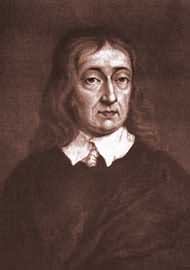
John Milton went completely blind in 1652. He had already written a number of sonnets and other works, and one would think that writing would have to stop when sight stopped, right? Wrong. Milton actually “wrote” his epic poem Paradise Lost in the 1670s by dictating it to his daughter (I believe). He also continued to write other essays and poetry, including this sonnet that he wrote soon after he had gone blind:
When I Consider How My Light Is Spent
When I consider how my light is spent,
Ere half my days in this dark world and wide,
And that one talent which is death to hide
Lodged with me useless, though my soul more bent
To serve therewith my Maker, and present
My true account, lest He returning chide;
"Doth God exact day-labor, light denied?"
I fondly ask. But Patience, to prevent
That murmur, soon replies, "God doth not need
Either man's work or His own gifts. Who best
Bear His mild yoke, they serve Him best. His state
Is kingly: thousands at His bidding speed,
And post o'er land and ocean without rest;
They also serve who only stand and wait."
Now here is a man who has overcome his disability. This sonnet speaks to a lot of the things that we brought up in our discussion, mainly the question of “What would you do if you became blind now, after having eyesight all your life?” How would you react if your “light” were suddenly “spent” (extinguished)? Milton accepts it. He appreciates the light that he was given before, and understands that he can continue to serve his God (he was a Puritan, by the way), even without the gift of sight.
Blind people are not without sight. If anything, they have more. The other senses become heightened, and I believe that includes some senses that those of us with eyesight don’t know that we have. In a way, people with disabilities are more appreciative of their dignity because they have to work harder to uphold it in this world of people who can see. It’s easier for us with eyesight to violate dignity because we only see without really looking. We rush without appreciating. We aren’t as careful as we should be because we are caught up in superficiality and make judgment calls based on what we see without taking the time to go deeper.
I suppose what I’m trying to say is that we should maybe take a cue from Milton (if nothing else) and recognize the gifts we’re given that are more than just what we can see. We should appreciate them both in ourselves and in others.

First of all, I laughed at your pun - am I terrible person? Second of all, you writing about Milton overcoming his disability reminded me of Stevie Wonder's song "Isn't She Lovely?" (http://www.elyrics.net/read/s/stevie-wonder-lyrics/isn_t-she-lovely-lyrics.html) He wrote the song about his daughter, whom he was never able to see due to his blindness. Yet the absolute love he had for her is almost tangibly present in both the lyrics and the performance of the song.
ReplyDelete